People ask me how long you really need in Leptokarya, and my honest answer is a week. A weekend gets you the beach and a decent dinner, but it misses the thing that makes this stretch of the Pierian coast special, which is that you can wake up to the Aegean and be standing in a gorge on Mount Olympus by mid morning. We sit right at the foot of the mountain, with the sea on one side and Olympus on the other, and a scatter of castles, ruined cities and hill villages in between. Seven days is enough to slow right down, take the beach days you came for, and still fold in the history and the mountain without ever feeling rushed. Here is how I would spread a relaxed week, the way I would plan it for friends who came to stay. Treat it as a loose frame rather than a timetable, and swap days around freely if the weather turns.
Day 1: Arrive, unpack, and let the pace drop
Most people reach us by car down the main north to south road, or by the slow train that stops at the little Leptokarya station, and either way you will probably arrive warm and slightly frazzled. Do not try to do anything clever on the first day. Find your room, put your bags down, and walk to the sea. If you want the full picture of the routes in, I have written a separate guide on how to get to Leptokarya, and another on where to stay in Leptokarya if you have not booked yet. The village itself is small and walkable, a knot of streets that thickens in the evening as families come out. My advice for the first night is simple. Buy a cold drink, find the seafront, and watch the light go pink over the water while Olympus turns dark behind you.
For dinner, keep it easy. There are fish tavernas near the front and a good bakery in the village for tomorrow’s breakfast, and you do not need a reservation on a normal night. If you want my longer list of tavernas and where the locals actually eat, it is over in the best restaurants in Leptokarya guide. Get an early night. The mountain will still be there in the morning, and the point of day one is to shed the journey, not to fill it.
Day 2: A proper beach day
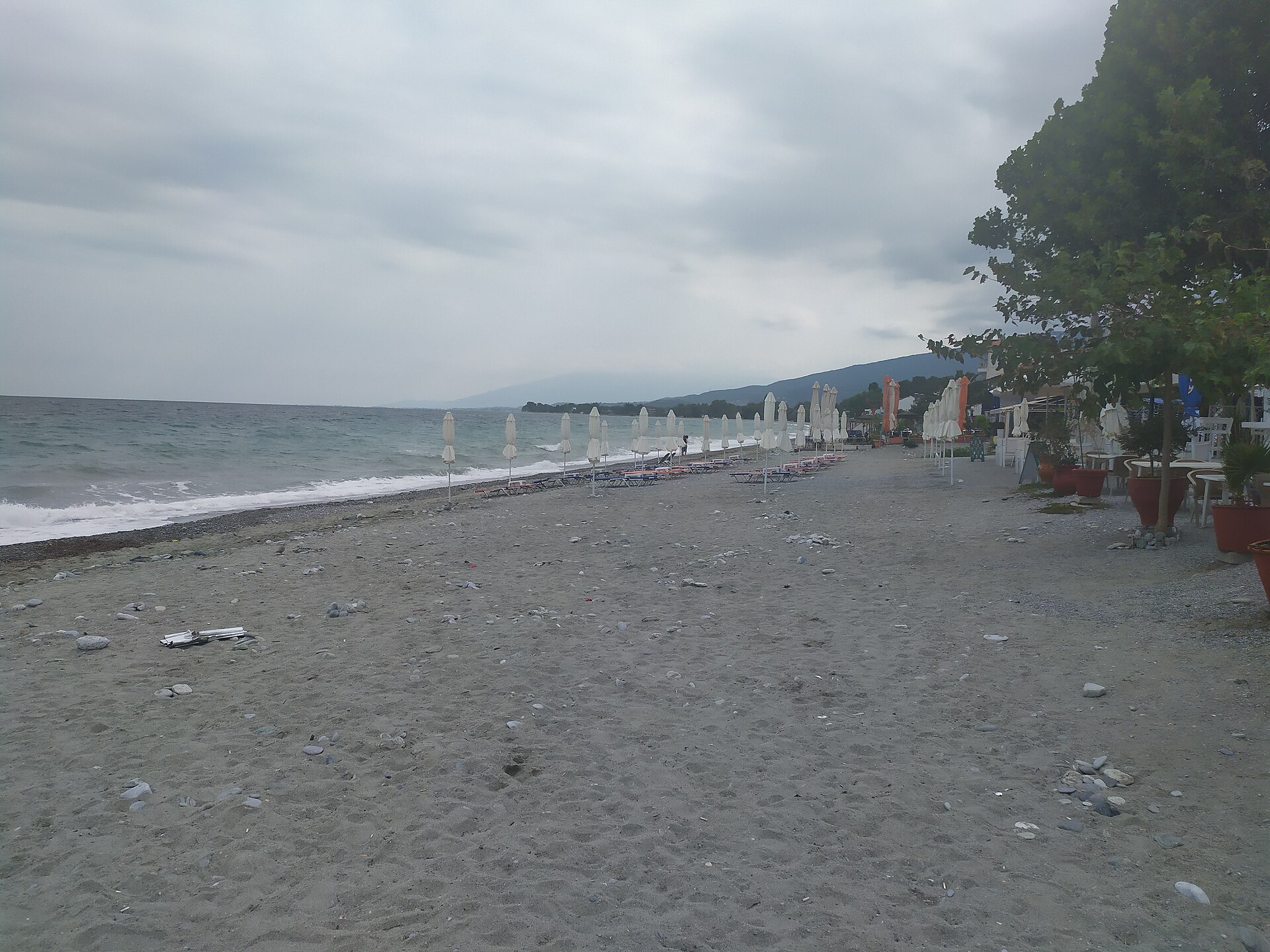
Now that you have landed, give yourself a full day doing very little. The Leptokarya beach runs long and is mostly fine shingle and sand, shelving gently, which makes it easy going for children and for anyone who is not a confident swimmer. There are stretches with sunbeds and a beach bar or two, and stretches where you can just lay a towel down and hear nothing but the water. If you fancy a change of scene, the coast either side rewards a short drive. Skotina beach to the north and the longer sands down towards Nei Pori are both easy hops, and each has its own character. I have mapped out the options, including the quieter coves, in the best beaches near Leptokarya guide.
A beach day here is at its best when you do not fight the rhythm of it. Swim in the morning while the sea is calm, retreat for a long lunch and a rest through the hottest part of the afternoon, then come back for a second swim as the crowds thin. A few things I always tell guests to bring:
- Water shoes if you have tender feet, because the shingle sections can be sharp underfoot
- More water than you think you need, and a hat, since the sun off the sea is stronger than it feels
- A bit of cash for the beach bar and the sunbeds, as not everywhere takes cards
- A book you can actually finish, because you will have the time
- A light layer for the evening, when the breeze off Olympus can turn the front cool
If you are travelling with little ones, the shallow water and the room to run around make this an easy day, and there is more on that in my notes on family holidays in Leptokarya with kids.
Day 3: Up the mountain, to Litochoro and the Enipeas gorge
This is the day the mountain stops being a backdrop and becomes the whole point. Drive north to Litochoro, the handsome town that acts as the gateway to Mount Olympus. Start at the national park visitor centre, which is worth an hour in its own right. Travellers who have been through it describe a small museum covering the mountain’s history, plants and wildlife, and a three dimensional scale model that finally makes sense of how the gorge cuts up into the massif. The staff there will show you a map and point you to a sensible place to start, which matters, because the full Enipeas gorge trail runs a long way from the town up to a spot called Prionia, and most visitors sensibly walk only the best stretch of it rather than the whole thing.
What people remember from this walk is the feel of it. The path threads along the river through dense green, crossing wooden bridges, past the old monastery of Saint Dionysios, with waterfalls and clear pools along the way. One traveller I read described the lower section as steadily uphill but not punishing, then the stretch above Prionia turning noticeably steeper with more steps. Another wrote about a friendly local dog, bell on its collar, that simply adopted their group and trotted ahead like a guide before peeling off home. That is very much the spirit of the place. A word of honest caution though. This is a mountain, not a park path, so wear proper shoes, carry water, and give yourself time. People who drive up to the trailhead warn that the last couple of kilometres back into town can crawl at busy times, and everyone agrees you want to be off the mountain well before dark. Prionia is as far as most day walkers go. The actual summit is a serious multi day undertaking and not something to wander towards on a whim.
Reward yourself afterwards. Litochoro is a lively little town with squares made for sitting in, and more than one visitor has confessed that the gelato there is dangerously good and seemingly on every other corner. Have a long, late lunch, and let your legs recover.
Day 4: Ancient Dion, the sacred city under Olympus
After a mountain day, Dion is a gentler kind of wonder. This was the sacred city of the ancient Macedonians, the place where their kings gave thanks before marching out, and today it is a large archaeological park spread across flat, green ground with Olympus rising behind it. Visitors often compare the scale of it to Pompeii, and they are right to. You wander among the streets of the old city, sanctuaries, Roman baths and ancient theatres, and the sheer spread of it is the point. Give it plenty of time and do not rush from ruin to ruin.
A few honest notes, because I would rather you arrived prepared. The site is watered by natural springs, which is beautiful but means parts can sit under water after wet spells, so decent footwear helps. Reviewers have found the on site signage and the free map fairly thin, so it is worth reading up a little before you go, or considering a guide if you want the stories brought to life. There is parking, a café and toilets on site. One thing that catches people out is that the excellent archaeological museum is a separate ticket in the nearby village of Dion, not inside the park, and there is no combined ticket, so plan to do both if you can. The museum is where the finest statues and mosaics live, and it pulls the whole site together. Entry fees and opening hours do change with the season, so check locally before you set off. Fair warning too that the park is vast and short on benches, so it is not the easiest for anyone with limited mobility.
Day 5: Platamonas castle and Old Panteleimonas
Head south today for a pairing that gives you a castle and a mountain village in one easy loop. You will spot Platamonas castle long before you reach it, crowning its own rocky hill above the sea, so prominent that one writer joked it would take an act of will to drive past it. It has guarded this coast for a very long time, sitting at the doorway between Macedonia and the south, and there is far more history packed into it than the postcard view suggests. Under the medieval walls lie the remains of an ancient town, and the great octagonal tower still stands stark against the sky. Wander the walls and you find old churches with faint traces of wall paintings, cisterns cut for the garrison’s water, even a surprise or two from more recent wars, since the hill was fought over as late as 1941. The reward at the top is the view, out over the Aegean one way and towards snow streaked Olympus the other on a clear day.
Two practical things. The entrance fee is modest, but check locally, and it is a short uphill walk to reach the castle, so wear something other than flip flops. Visitors also note that the tall inner tower has at times been closed to climb, so do not build your whole visit around going up it. From the castle, wind up into Old Panteleimonas, the restored stone village in the hills above the coast. It is the kind of place people fall for, all cobbles and plane trees and little tavernas around a shaded square, with a friendliness that travellers mention again and again. Have a coffee or a slow lunch up there, enjoy the cool air, and take in the view back down to the sea. It is one of my favourite half days on this whole coast.
Day 6: A slow day of food and villages
By now you have earned a day with no monument attached to it. This is the day to eat well and potter. Start with a proper Greek breakfast from the village bakery, then let the day unfold. You might drift up to one of the foothill villages for the morning, or simply stay in Leptokarya and treat it as an eating day, moving from a mid morning coffee to a long taverna lunch to a sunset drink at a beach bar, with a swim or two folded in between. The point is to do it at the speed the locals do, which is to say slowly.
This is also a good day to buy something to take home. The Pierian foothills are olive country, and you will find small producers offering oil and honey and local herbs, the kind of thing that tastes of the trip long after you are back. If you want a steer on which tavernas do the grilled fish properly and which do the best home cooking, my restaurants guide has the honest version, and there is a wider round up of low key options in my list of things to do in Leptokarya for anyone who cannot sit still. Do not underestimate a day like this. A week that is all castles and gorges leaves you needing a holiday from your holiday, and this is the day that stops that happening.
Day 7: One bigger day trip
Save one proper excursion for the end, when you know the coast well enough to appreciate leaving it for a day. You have three strong options, and which you pick depends on your appetite for driving. Thessaloniki is the easy one, a little over an hour up the road, a big, characterful city with a waterfront, markets, Byzantine churches and some of the best eating in northern Greece. It makes a relaxed day. Vergina is closer still and quietly astonishing, the royal tombs of the Macedonian kings displayed underground exactly where they were found, including the tomb widely linked to the father of Alexander the Great. If you liked Dion, you will find Vergina unforgettable.
Then there is Meteora, the monasteries perched on their impossible rock pillars. It is the most spectacular of the three and, I have to be honest, the longest day. People sometimes quote it as around a two and a half hour drive, but locals and seasoned visitors will tell you to budget more like four to five hours each way once you account for the mountain roads, which makes it a very long day if you self drive. If Meteora is the one you truly want, an organised tour from the coast can be the saner choice, since someone else takes the wheel and you keep your energy for the monasteries. Whichever you choose, set off early, and I have gathered the full set of options, distances and tips in my dedicated guide to day trips from Leptokarya.
A few closing thoughts
What I love about a week here is the balance of it. You can have the beach holiday you pictured and still come home having stood in a gorge on Olympus, walked a sacred ancient city and looked out from a castle wall over the sea. Nothing on this list is more than a short drive away, which is the quiet magic of Leptokarya, and it means you never spend your holiday sitting in a car. If you are still deciding when to come, the shoulder months on either side of high summer are lovely, with warm sea and thinner crowds, and I have written more about that in my notes on the best time to visit Leptokarya. Come, take it slowly, and let the mountain and the sea do the rest. That is the whole secret, and it is not much of a secret at all.