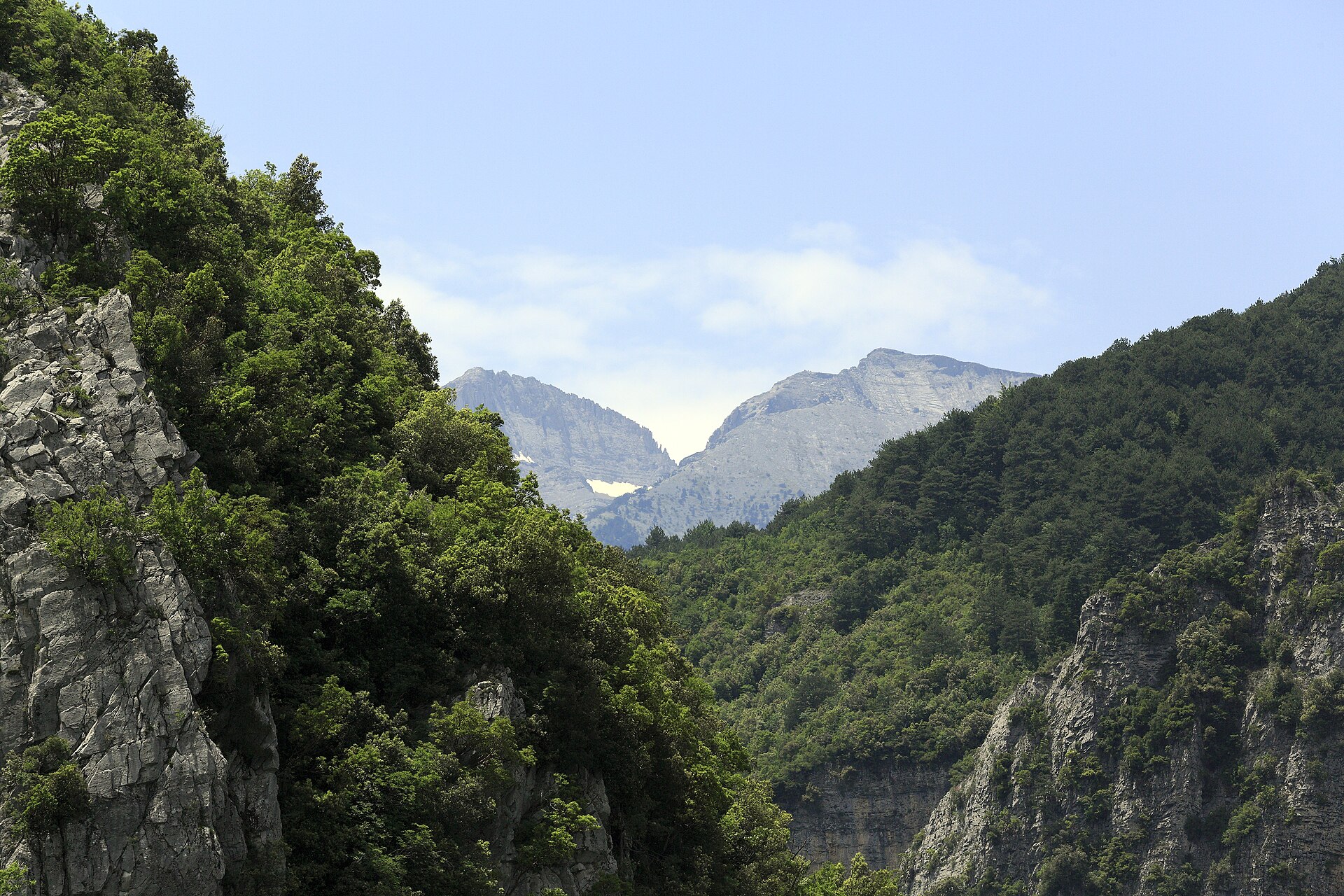
From almost anywhere in Leptokarya you can look up and see it. Mount Olympus fills the western sky, its top often wrapped in cloud even when the beach is in full sun, and after a few days here you stop taking it for granted. The good news is that you do not need to be a mountaineer to experience it. From our little stretch of the Pierian coast the mountain is close enough for a morning drive, and there is a version of an Olympus day for almost everyone, whether you want a shaded gorge walk beside a stream, a waterfall to cool off in, an ancient city among the trees, or a serious climb towards the roof of Greece. This is my honest guide to doing it from a Leptokarya base.
I am Yogochun, a local guide with family on this coast. I will point you to the places I know are worth your time, keep the real caveats in, and ask you to check current times, fees and trail conditions locally rather than trust an exact number from me, because on a mountain those things change with the season and the weather. For the wider picture of what else is within reach, see my guide to day trips from Leptokarya.
Litochoro, the gateway to the mountain
Every Olympus trip begins in Litochoro. It is the old stone village that sits where the coastal plain rises into the mountain, and it is only a short drive from us, roughly ten kilometres south and inland, perhaps fifteen minutes in the car. It has always been the climbers’ town, with a mountaineering feel to it, walking shops, tavernas, and a small square where you can plan the day over a coffee. Even if you never set foot on a trail, Litochoro is a lovely couple of hours in itself, and the views up into the mouth of the gorge from the top of the village are wonderful.
Most people arrive by car, which is much the easiest way to reach the mountain from Leptokarya and to link the different sights together. If you would rather not drive, there are guided day tours that pick up along this coast, and Litochoro has its own railway station down on the plain, a few kilometres from the village itself. For the general transport picture, my notes on how to get to Leptokarya will help you work out your options.
The Enipeas Gorge walk from Litochoro
If you only do one walk on Olympus, make it the Enipeas Gorge. This is the deep, green ravine that runs up into the mountain from Litochoro, and the path through it is, to my mind, the single best way for an ordinary walker to feel the scale of the place. The full route runs between Litochoro and Prionia, the trailhead high up the mountain, and it is a proper day out, something in the order of twelve kilometres one way with plenty of ups and downs, though the trail itself is well marked and easy to follow. Reckon on most of a day once you allow for stops, and most walkers find it easier to be dropped at Prionia and walk down towards town, so more of the effort is descent.
What makes it special is the mix. You cross the stream again and again on little wooden footbridges, you pass waterfalls and clear pools where people stop to cool their feet on a hot day, and about halfway you reach the old monastery of Agios Dionysios, tucked into the rock, which is a natural place to rest and take it in. The landscape keeps changing as you go, from tight, shaded rock to open views back down towards the sea. One honest word of caution: the bridges and boardwalks take a battering from winter floods, and sections have been closed for repair in the past, so it is worth asking in Litochoro whether the full route is open before you commit to it.
If a full day feels like too much, especially with children or in high heat, there is a gentle alternative. From the Myloi end at the top of Litochoro you can walk a short, easy stretch into the mouth of the gorge to reach a first waterfall and turn back, which gives you a real taste of it in an hour or so. This lower part is one of the nicer things to fold into a beach-based holiday, and I mention it in my roundup of things to do in Leptokarya.
What to pack for the gorge
- Proper walking shoes or boots with grip. The rocks and wooden bridges get slippery near the water, and trainers are not ideal for the full route.
- More water than you think you need, plus a snack. There is little to buy once you are on the trail.
- A hat, sunglasses and sun cream for the open sections, and a light layer, as it is noticeably cooler and damper down among the rocks.
- A swim towel if you fancy dipping your feet or more in the pools. The water is cold even in summer.
- A charged phone, a paper map or offline map, and a rough idea of your turnaround time so you are not caught out by the length.
- Insect repellent and a small first aid kit for the longer walk.
Prionia and the serious climb to the peaks
Prionia is where the mountain gets serious. It is the end of the winding road above Litochoro, a good forty minutes of hairpins up from the village, and it amounts to little more than a car park, a spring and a simple taverna. For most visitors it is a fine destination in its own right, a place to breathe the pine air, eat a plate of something and look up at where the real climbers are heading. It is also the trailhead for the ascent proper.
I want to be completely honest about what that ascent involves, because the name Olympus makes it sound romantic and the reality is hard work. From Prionia the main path climbs steeply through forest to the mountain refuges, most famously Spilios Agapitos, gaining something close to two thousand metres of height. Reaching the true summit, Mytikas at 2,918 metres, is a demanding hike rather than a technical climb, but the final stretch is an exposed scramble over loose rock where a helmet is sensibly worn, because climbers above can dislodge stones. People who have done it describe roughly seven hours up and four back, and almost everyone recommends splitting it over two days with a night in a refuge rather than rushing it in one. The season is broadly June to October, and outside that you are into snow and a different sport entirely.
So who is it for? Fit walkers with some mountain experience manage it without a guide in good weather. If you are uneasy with heights, loose ground or route finding, the final section to Mytikas is exactly where that matters, and hiring a certified mountain guide is money well spent. If a summit is not your goal, do not feel you are missing out. Many of the finest views on the whole massif are from the plateau and the lower peaks around the refuges, not from the top itself, and simply walking a couple of hours up from Prionia towards the tree line, then turning back, gives you the forest, the height and the sea appearing below you. This is context, not a dare. Know your limits and the mountain will reward you either way.
The Orlias waterfalls
For a shorter, more family-friendly taste of the mountain’s water, the Orlias falls are a lovely half day. They sit on the eastern flank of Olympus, up above the plain near Dion, reached by a paved road of a few kilometres that climbs from the main road to a little chapel at Agios Konstantinos. The area around the chapel has been laid out with wooden tables, benches and cold spring fountains, and in summer it gets busy, so expect a line of parked cars at the end of the road on a hot weekend.
From there a signed trail follows the Orlias stream up through shade, past a couple of accessible lower waterfalls with viewing platforms, towards the star of the show, the Red Rock Waterfall. The walk to it is a continuous but manageable uphill of around an hour at an easy pace, with a spring and a bench about halfway to catch your breath, and the round trip is well within the reach of most people who are reasonably active. The reward is crystal-clear water that stays cold even in the height of summer, framed by vivid green, the sort of spot where you dip in and gasp and grin at the same time. Two honest notes: the last section involves crossing the stream and a steeper stretch or two, so children need a hand and a close eye, and the rocks are slippery. Good footwear beats flip-flops here every time. Families weighing up an Olympus day may also like my guide to family holidays in Leptokarya with kids.
Ancient Dion, the sacred city at the foot of Olympus
If the mountain is where the gods lived, Dion is where the ancient Macedonians came to worship them, and it is my favourite gentle Olympus day of all. This was the most sacred site in Macedonia, the place where kings gave thanks and held festivals before their campaigns, and its very name comes from Dias, or Zeus. The archaeological park lies on the plain right at the mountain’s foot, an easy drive north from Leptokarya of maybe fifteen or twenty minutes, and it is a wonderful thing to wander.
What surprises people first is how green and watery it is. The site sits on wetland fed by mountain springs, so you walk on raised boardwalks and paths between channels of clear water, past the sanctuaries of Zeus, Demeter and the Egyptian goddess Isis, the Roman baths with their under-floor heating, the theatres, and grand villas with mosaic floors, the famous one showing Dionysus. The streams and marshy pools are alive with terrapins and frogs, and the whole park is shaded like a big city garden, which makes it a blessing on a hot day when the ruins of the coast are baking. It is large, so allow a good two to four hours, and there is a small cafe, toilets and parking at the entrance.
A few practical things I have learned. There is a modest entry fee, and the excellent museum with the finest statues is a separate building in Dion village a short distance away, usually a separate ticket, so budget time for both. Bring a hat and water, because although the park is shady it is big and there is a lot of walking. And after wet spells some low-lying parts, including the Isis sanctuary reached by a little bridge, can be flooded and closed off, so you may not see every corner. None of that spoils it. Standing among fallen columns with the mountain rising straight behind you, it is not hard to feel why they thought this ground was holy.
The home of the gods
Half the pleasure of an Olympus day is the story you carry with you. This is the mountain the ancient Greeks made the home of the twelve gods, with Zeus enthroned at the top, and the two highest points still carry that idea in their names, Mytikas the peak and Stefani, the throne of Zeus. You do not have to believe a word of it to feel it. When the cloud sits on the summit and burns gold at the end of the day, or when the sun comes up over the Aegean on one side while the great grey wall of rock glows on the other, the myth stops feeling like a schoolbook and starts feeling like an obvious explanation. Even a coffee in Prionia or a slow hour among the trees at Dion gives you a little of that atmosphere, which is why I send every visitor up there at least once.
Guided tour or do it yourself?
Both work well from here, and the right answer depends on the day you want. Doing it yourself with a hire car gives you total freedom to combine, say, a morning at Dion with an afternoon at the Orlias falls, or to walk the lower gorge at your own pace and be back on the beach by evening. It is cheaper and more flexible, and the easier sights need no expertise at all.
A guided tour earns its place in two situations. The first is the summit. For the serious climb to the refuges and Mytikas, a certified mountain guide is genuinely worth it unless you are an experienced hiker, both for safety on the exposed final rock and for the reassurance of someone who knows the route and the weather. The second is convenience: there are well-run day tours that bundle Dion, the Olympus foothills and a village or gorge walk together with pick-up from the coast, which is ideal if you are not driving or simply want the logistics taken off your hands. Whichever you choose, go early in the day, both for the light and to beat the summer heat, and think about when in the year you come. My notes on the best time to visit Leptokarya apply to the mountain too, with late spring and early autumn giving you kinder walking weather than the peak of August.
A simple plan from Leptokarya
If you have one day, I would drive to Litochoro first thing, walk as much of the lower gorge as suits your group, then drop down to Ancient Dion for the afternoon when a bit of shade is welcome. If you have two, add the Orlias waterfalls on the second morning, or drive up to Prionia for lunch and a short walk into the forest to feel the height. And if you are a walker with the fitness and the experience, give the summit its own two days and a refuge night, and treat Leptokarya as the soft landing to come back to afterwards, with a beach and a cold drink waiting. However you do it, the mountain of the gods is far closer and far more welcoming than its reputation suggests, and it is one of the real privileges of a holiday on this coast.